
How to Choose the Right Therapist: The Ultimate Practical Checklist

Finding a mental health professional can feel overwhelming, especially when the internet is filled with conflicting titles and unverified practitioners. If you want to bypass the guesswork and protect your time, money, and mental health, here is a practical checklist on how to choose a real professional and avoid common traps.

1. Verify the License First

In most major cities, anyone can attempt to offer guidance, but you need to check for an active, official license. Unfortunately, a significant number of individuals circumvent licensing laws by using unregulated terms that fall outside legal restrictions—such as life coach or professional advisor. A quick online search of state or regional licensing boards will instantly separate the qualified professionals from the untrained pretenders.

2. Investigate Their Specific Experience

Once you find a licensed individual, look closely at their background regarding the specific problem you are facing:

  • Have they taken specialized courses in your area of struggle?
  • Have they taught in the field or published research addressing these topics?

These are essential markers for determining true clinical competence rather than general, surface-level familiarity.

3. Demand Objective Measures and Testing

A major, yet frequently overlooked requirement of quality healthcare is the objective measures a therapist uses to support their diagnosis, progress tracking, and hypotheses about you.

  • You would never visit a medical doctor who refuses to run any medical tests or confirm a diagnosis with data.
  • Why expect any less of a therapist?

In fact, research shows that mental health professionals who do not utilize objective measures to track a client’s status tend to show minimal professional improvement with experience. Real therapy relies on measurable tracking, not just endless talking.

4. Understand Their Approach and Continuing Education

Find out how the practitioner stays up to date with the field and learns the latest evidence-based treatments. Generally, an educated, integrative approach is best—meaning the therapist has developed real competence in several proven methods and applies strict criteria to choose the one most appropriate for your specific problem.

5. Evaluate Logistics, Billing, and Rates

Finally, look into how they bill, how they handle insurance, and how their rates compare with others providing similar services. Keep in mind a golden rule of healthcare: the very best practitioners do not necessarily charge the highest fees. Focus on value, clinical depth, and verifiable skill rather than a flashy price tag.

To read the complete professional and in-depth article that serves as the foundation for this blog, check out the full guide How to Select a Psychologist, Therapist or Counselor at psychology.ws


Why Insight Alone Won’t Save You: The Myth of the “Quick-Certificate Expert”

When looking for a mental health professional, it is very common to stumble upon therapist websites claiming they practice dynamic or psychoanalytic therapy, tracing everything back to your childhood, while simultaneously throwing in CBT (Cognitive Behavioral Therapy) “when appropriate.”

To put it bluntly: this is like a medical doctor claiming they use crystal healing, but will apply real scientific medicine when necessary.

The Illusion of the “Overnight Expert”

The massive surge in research supporting CBT has led many poorly trained therapists to claim they use this approach, often after attending nothing more than a superficial, fast-track workshop or buying into a quick-certificate trend.

What makes this trend particularly vexing is that cognitive therapies are not functionally compatible with traditional dynamic psychotherapies. Traditional dynamic approaches predicate their treatment on giving the client insight into the origin of their problems, positing that insight alone cures.

Categorically, this is absurd.

Why Discovering Your Past Isn’t Enough

If you find out you have low self-esteem because you had poor bonding with your mother, do you really think that simple discovery will make it go away?

Sadly, things are not that easy. Like all major life changes, emotional health requires hard work, practice, and a genuine commitment to change.

As research shows, we have a strong tendency to disturb ourselves emotionally through self-indoctrination—internalizing self-defeating beliefs and magical, “unvalidated” thinking (such as the irrational idea that “Everyone must love me”). Blame sits right at the core of most emotional disturbances. But realizing you do it is only step one.

How to Choose the Right Approach

Because psychotherapists are so often self-restrained by dogmas derived from specific schools of thought, whether psychodynamic, Rational Emotive, Cognitive, or Interpersonal, the consumer of mental health services needs to be careful.

When evaluating a practitioner, you have to ask two critical questions:

  1. Is the therapist actually, thoroughly trained in all of the approaches they claim to use?
  2. On what grounds do they actually switch approaches, and how does it benefit the client?

Although a therapist’s raw talent is a key factor in therapeutic efficacy, real healing requires moving past the illusion that an “ah-ha!” moment in a session is enough. Real change takes structure, cognitive restructuring, and sweat.

To read the complete professional and in-depth article that serves as the foundation for this blog, check out the full guide “The role of therapist training and life problems” at psychology.ws.

Couples in Crisis: Psychologist or Psychiatrist? Mallory Creek Retreat vs. A Pill

When a relationship hits rock bottom, everything feels urgent. The arguments loop in endless circles, trust feels fractured, and the default panic response is often to look for a quick fix, wondering if a prescription can numb the pressure or if a medical doctor can make the chaos stop.

But when your relationship is breaking down, a psychiatrist with a prescription pad is addressing the wrong address. For couples trapped in destructive patterns, emotional avoidance, or chronic conflict, a pill is never the answer. A deep, immersive psychological approach is. Here is why choosing Mallory Creek Retreat is the turning point your relationship actually needs.

Pills Lower the Temperature, But They Don’t Fix the Relationship

Let’s be honest: when anxiety or depression paralyzes one or both partners, medical intervention can sometimes lower the biological temperature. It can help you sleep or stop a panic attack from running the show.

However, no pill on earth knows how to resolve a toxic cycle of pursuit and withdrawal. A prescription cannot teach you how to communicate during a screaming match, how to rebuild trust after infidelity, or how to stop organizing your shared life around resentment and fear. Those are behavioral and psychological tasks. They require active, focused treatment, not a chemical blanket.

Why Standard Weekly Therapy Often Fails Couples

Most couples in deep crisis make the mistake of booking standard weekly therapy sessions, only to find that it leaks like a sieve. You spend 50 minutes unpacking a fight, go home for six days and twenty-three hours, and immediately recreate three new arguments before you ever see the therapist again.

Expert Guidance Built for Real Breakthroughs

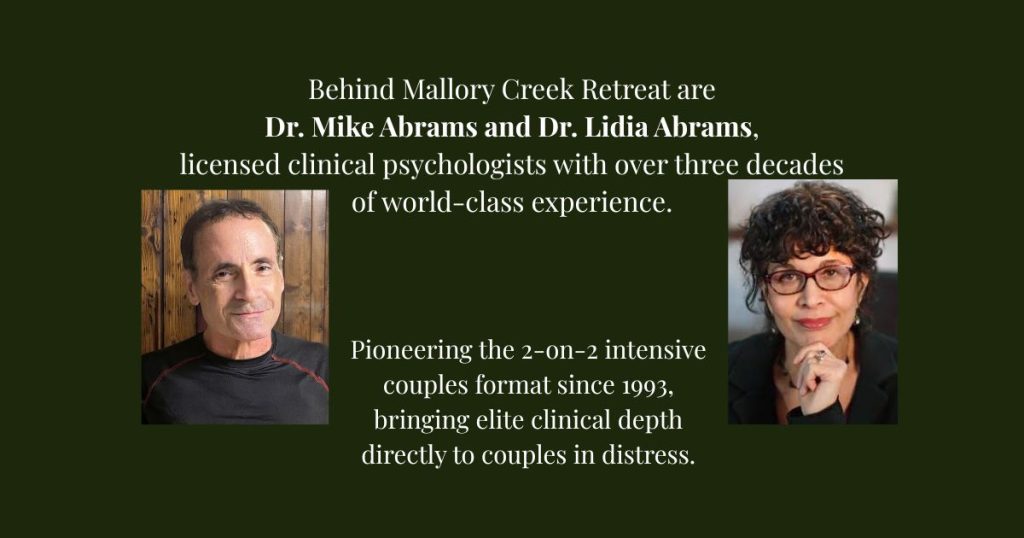
At Mallory Creek Retreat, leading psychologists Dr. Mike Abrams and Dr. Lidia Abrams approach deep-seated relationship distress differently. Instead of offering passive, generic encouragement or letting you endlessly spin your wheels, their intensive program is structured, rigorous, and focused entirely on understanding what is happening, why you keep triggering each other, and how to break the loop for good.

Stop Chasing Quick Fixes

If you are looking for medical management of severe clinical symptoms, a psychiatrist is essential. But if you want to change longstanding patterns, heal emotional distance, and learn how to navigate conflict without destroying each other, you need expert psychological intervention.

Don’t spend another month collecting vague advice or waiting for a pill to magically fix a relational wound. Put your relationship in the hands of experienced clinicians like Dr. Mike Abrams and Dr. Lidia Abrams at Mallory Creek Retreat, and find a clear, purposeful roadmap back to each other.

To read the complete professional and in-depth article that serves as the foundation for this blog, check out the full guide on psychology.ws.

Chapter 7: Helping Couples Deal with Intimacy and Sexuality

Author: Dr. Mike Abrams

The Case of Hillary and Mark

Everyone Loves a Perfect Beginning… Until Year Four Arrives

Love affairs always begin magically. Hillary and Mark had a romantic wedding, which was entirely fitting for two people who were deeply in love. On paper, they looked like the picture-perfect couple. Hillary was a senior administrator for a pharmaceutical company, while Mark was a structural engineer balancing a full-time job with a part-time consulting practice.

During the first two years of their marriage, sex was frequent and intensely pleasurable, culminating in the birth of their daughter, Sara. As a family, they grew increasingly affluent and close.

Then reality struck hard.

By the fourth year of the marriage, the fairy tale turned into a battlefield. Hillary suddenly began loudly complaining about Mark’s assertiveness, his masculinity, and even his ability to discipline their daughter Sara.

“I Haven’t Changed at All!” – A Classic Couples Crisis

Mark was shocked, hurt, and deeply frustrated, firmly believing he hadn’t changed a bit and remained the same man Hillary fell in love with.

However, the real drama unfolded behind closed doors in the bedroom: Hillary completely withdrew from Mark sexually.

  • Initially, she denied this was happening, pointing to a single sexual encounter they had shared a month earlier.
  • When pressed further, she opened Pandora’s box, unloading a stream of complaints about Mark’s annoying behavior at home—especially his inconsistent parenting of Sara.

While articulate and intelligent, Mark was also quite shy and passive. Rather than openly expressing his hurt and anger over her constant complaining and sexual withdrawal, he kept it bottled up, turning sullen and passive-aggressive.

Behind Closed Doors in Counseling

When they finally stepped into a therapist’s office, Hillary knew exactly what she wanted to do: list every single flaw and failing of Mark’s while completely dodging the topic of sex, which happened to be crucial to Mark.

In an individual session, Hillary dropped the mask and admitted the raw truth: Mark simply didn’t arouse her anymore. Naturally, she blamed it entirely on his behavior.

Meanwhile, Mark used his individual sessions to sing the same tune, insisting he saw no changes in the relationship that could justify her complaints or sexual withdrawal. His quiet, entitled core belief was: “Hillary should act lovingly and be attracted to me because she is my wife.”

The Collision of Unrealistic Expectations and Shattered Illusions

The therapist had to step in and shatter this game of ping-pong by confronting them with their mutual delusions:

  1. Mark’s Unattractive Weakness: Mark admitted he could no longer open up to Hillary about his anxieties and life stressors. The therapist gave him a harsh dose of reality, explaining that the nature of their relationship had changed. While Mark’s past needs for emotional support used to evoke maternal feelings in Hillary, they had now become deeply sexually alienating and unattractive to her.
  2. Hillary’s Mind-Reading Demand: Hillary’s irrational demand was that Mark should magically know her behavior was a turnoff and change on his own without her ever having to ask.

When the therapist forced them to accept that they had both changed and that growth requires mutual acceptance, the real work began. Mark hated the idea of maintaining a façade of machismo just to keep Hillary attracted, while Hillary still felt she was compromising by staying. Nevertheless, once they tackled their irrational beliefs head-on, the relationship endured and passion returned.

[The text continues with sections on infidelity, evolutionary psychology, and relationship dynamics…]

Read the original full text and explore more resources on this topic via their official site:

The Case of Hillary and Mark & Full Text PDF