

What the Couples Intensive Is

The Couples Intensive is a multi-day, immersive clinical program, not a retreat, not a workshop, and not couples counseling in an extended format.

It is a structured therapeutic intervention designed to address the cognitive, emotional, behavioral, and intimacy patterns that maintain chronic relational dysfunction. 

The program is individualized from intake through follow-up.

Before the intensive begins, a comprehensive clinical assessment is conducted to identify the specific patterns, beliefs, emotional dynamics, and behavioral cycles driving each couple’s distress. The treatment plan is built from that assessment, not from a generic program template.

Structure and Format

The Couples Intensive takes place over two to three consecutive days at Mallory Creek in Chemung, NY. Daily sessions are intensive, structured, and clinically directed. The program includes:

The Clinical Model

The theoretical foundation of the Couples Intensive integrates several evidence-based frameworks:

Relationships are maintained not simply by what couples do, but by what they believe about themselves, their partners, and what relationships are supposed to feel like. The Couples Intensive works at the level of those beliefs and at the level of the emotional and behavioral patterns they generate.

Who This Program Is Designed For

The Couples Intensive is specifically designed for couples experiencing:


The program is selective. An intake consultation is conducted before acceptance to assess clinical appropriateness and determine whether the intensive format is the right fit for each couple. Couples with severe psychiatric conditions or safety concerns may be referred to more appropriate levels of care.

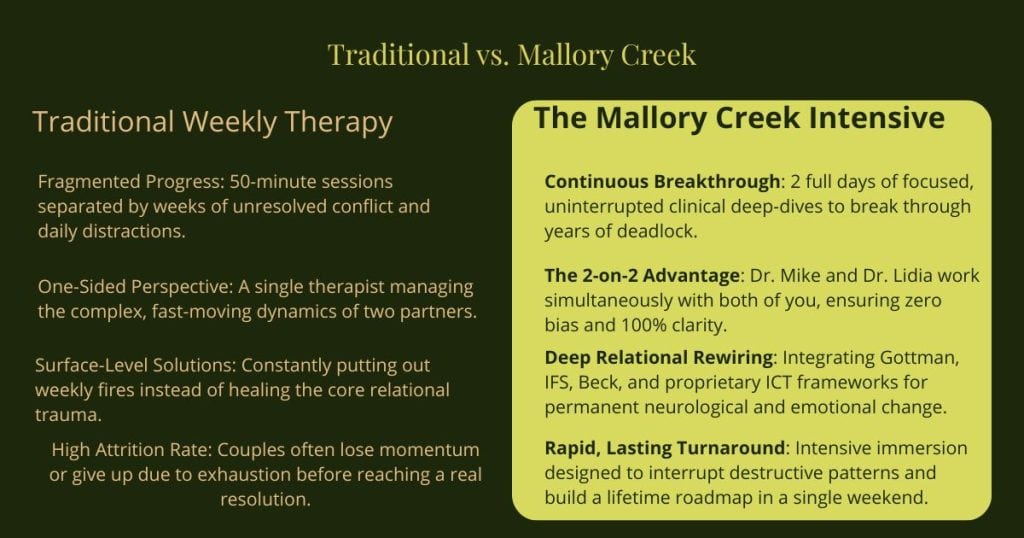
Why Standard Weekly Therapy Often Fails

Weekly therapy has structural limitations that are particularly pronounced in couples work:

Conflict continues between sessions.

Patterns reassert themselves.

Emotional disengagement deepens.

Each session begins with the work of rebuilding enough safety to resume and ends before the deeper material can be fully addressed. Standard couples therapy also tends to focus on communication skills, which are valuable but insufficient when the underlying problem is not a lack of skills, but a set of entrenched cognitive and emotional patterns that skills training alone cannot disrupt.

The Couples Intensive interrupts those patterns through sustained, immersive therapeutic work. The concentrated format creates momentum and continuity that weekly treatment rarely achieves.
Intimacy and Sexual Therapy

A significant proportion of couples who enter intensive treatment are experiencing some form of intimacy or sexual difficulty:

Desire discrepancy

Erotic disconnection

Sexual anxiety or performance anxiety

The relational aftermath of infidelity

Both Dr. Mike Abrams and Dr. Lidia Abrams bring specialized training in sex and couples therapy developed directly through their work with Albert Ellis, who was himself a pioneering figure in the clinical treatment of sexual and relational problems.

The Couples Intensive addresses intimacy and sexuality within a non-pathologizing, cognitively sophisticated, and empirically grounded framework:

Desire is understood in its biological and evolutionary context.

Sexual difficulties are understood as maintained by belief systems and behavioral patterns that can be identified and changed.

Assessing the Need for Intensive Couples Treatment: Critical Signs

A couple can spend months arguing about dishes, schedules, money, or sex while the real problem goes untouched: one partner no longer feels safe being honest, and the other no longer believes repair is possible. At that point, the question is not simply whether to start couples counseling, but when couples need intensive therapy, a more concentrated, clinically focused format designed for relationships that cannot afford another year of circular conflict. Based on clinical insights, here are the core signs that indicate when intensive couples treatment is necessary:

  1. The same fight keeps returning, with no real repair — The argument follows an almost mechanical script (criticism, defensiveness, escalation, withdrawal, resentment) and both partners can predict each other’s next sentence.

  2. Infidelity, secrecy, or betrayal has destabilized the relationship — Following a major breach of trust, weekly sessions can feel painfully slow, swinging between interrogation, avoidance, rage, and emotional collapse.

  3. Emotional or sexual intimacy has largely disappeared — The home feels like a business arrangement, or sexual difficulties (such as low desire, pain, avoidance, or mismatched expectations) have been avoided for so long.

  4. One or both partners are in significant psychological distress — Depression, severe anxiety, trauma reactions, intense jealousy, or emotional instability enters the relationship, making conflict volatile and confusing.

  5. Major decisions cannot wait for slow progress — The couple faces immediate consequences—such as whether to separate, how to disclose an affair, or how to manage a parenting crisis—and needs clinical time to think clearly rather than fighting.

  6. Weekly sessions have become a place to report conflict, not resolve it — Conventional therapy has become a weekly debrief where the couple gains insight and promises to do better, only to return with fresh evidence that nothing has changed.

  7. The relationship is in crisis, but both partners still want an honest evaluation — Neither partner wants to make an irreversible decision without a serious, candid attempt at treatment to examine their own role in the pattern.

Urgency and Recommended Action Table

Number of Recognized SignsUrgency LevelAssessment and Recommended Next Step
1 signEarly Caution SignsRecurring disagreements or initial distance are present. This is the right time for a consultation before patterns become deeply entrenched.
2 to 3 signsPlanning Intensive TreatmentThe foundations of the relationship are shaken (infidelity, loss of intimacy, or chronic arguments). It is recommended to slowly and consciously plan your arrival and stay at Mallory Creek Retreat for structured work.
4 signsSerious Crisis / Call SoonSignificant psychological stress is present, or weekly sessions no longer bring progress. It is necessary to secure a concentrated treatment format.
5 to 6 signsHigh UrgencyThe relationship is in deep crisis, decisions cannot wait, and conversations are reduced to repeating conflicts. Fast and direct clinical intervention is needed.
All 7 signsCritical / Act ImmediatelyThe cost of delay is too high, threatening permanent damage to the relationship and mental health. Immediate, uncompromising action and a focused arrival without delay are required.

Note: If you wish to read more, this assessment is based on the article “When Do Couples Need Intensive Therapy? 7 Signs” available on psychology.ws.

After the Intensive

A structured follow-up plan is developed for each couple before departure, including: